
Elmhurst’s Damp and Mould Scheme: A Practical Way to Support Landlords
The introduction of Awaab’s Law has increased the pressure on social landlords to respond quickly and appropriately to damp and mould concerns. Landlords need processes that allow them to assess reported issues, gather evidence, keep clear records and decide what action is required.
In many cases, the first step does not need to be a full specialist damp diagnosis. What landlords often need is a prompt, structured and non-intrusive assessment that helps them understand the visible condition of a property and decide whether further action or specialist investigation is required.
Elmhurst’s Damp and Mould Assessor Training and Competency Scheme has been developed to support this need. It gives landlords access to trained, registered and quality-assured assessors who can carry out consistent assessments and provide clear reports to inform the next stage of action.
A proportionate first step
Not every report of damp and mould will require specialist investigation at the first stage. Some cases may be minor, localised or capable of being addressed through straightforward remedial action. Others may be more complex, severe, recurring or technically uncertain, and should be escalated to a specialist.
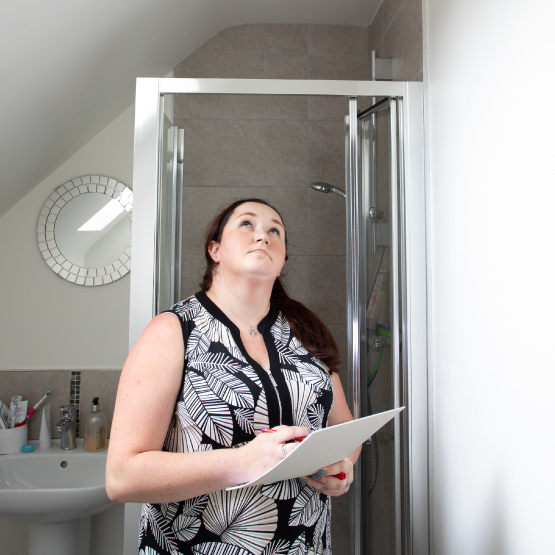
Assessors on the Elmhurst scheme carry out non-intrusive property assessments designed to help landlords understand the visible condition of a home, identify potential damp and mould risk, and decide what the appropriate next step should be.
This supports a more efficient process for landlords and housing providers, while helping residents receive a timely and appropriate response.
Supporting better decision making
The value of the scheme is in the practical outcomes it supports. It helps landlords to:
- respond more quickly to damp and mould concerns
- gather consistent evidence from property visits
- understand the visible condition of the home
- identify potential risk factors
- decide whether further investigation is required
- prioritise specialist expertise for the cases that need it most
- support clear records and auditable decision making
This is particularly important for social landlords managing large numbers of homes. A consistent, scalable assessment process can help them deal with reported issues more effectively, without automatically escalating every case to a specialist damp and mould expert.
Competence, consistency and assurance
Those on the Elmhurst Damp and Mould Assessor Competency Scheme are registered, trained, insured, quality assured and required to follow a code of conduct. They use approved assessment software, follow a consistent reporting methodology and complete ongoing CPD each year.
This gives landlords confidence that assessments are being carried out in a structured and professional way, and that reports are consistent, practical and capable of informing the next stage of action.

Making best use of specialist expertise
Specialist damp and mould professionals play a vital role, particularly where cases are complex, severe, recurring or technically uncertain.
Elmhurst’s scheme is not designed to replace that expertise. It is designed to help landlords use it more effectively.
Feedback from social landlords shows that accessing suitably qualified damp and mould experts across the country can be difficult, expensive and time-consuming. By introducing a structured first-stage assessment, landlords can identify which cases may be managed through proportionate action and which require further specialist investigation.
This helps reduce unnecessary cost and delay, while ensuring that expert input is directed to the properties where it will have the greatest impact.
Supporting Awaab’s Law response processes
Awaab’s Law places legal responsibilities on social landlords. Those responsibilities cannot be transferred to an assessor.
The role of the assessor is to provide competent, structured information that supports the landlord’s decision making. This may include identifying visible evidence of damp and mould, recording relevant risk factors, and helping the landlord determine whether remedial action, escalation or specialist investigation may be required.
In this way, Elmhurst’s scheme can support landlords’ Awaab’s Law response processes by helping them gather clear, consistent and auditable evidence at an early stage.
Conclusion
Elmhurst’s Damp and Mould Assessor Training and Competency Scheme provides landlords with a practical and proportionate way to support damp and mould risk assessment.
It enables trained, registered and quality-assured assessors to carry out non-intrusive property assessments, record consistent evidence and help landlords decide what action may be needed.
For social landlords responding to the demands of Awaab’s Law, this approach supports faster triage, clearer records, better decision making and a more efficient use of specialist expertise.
Damp and Mould Assessor Training
Find out more about our specialise Damp and Mould Assessor training below. Elmhurst members can currently save 20% on this training through our Next Level initiative.
FIND OUT MORE