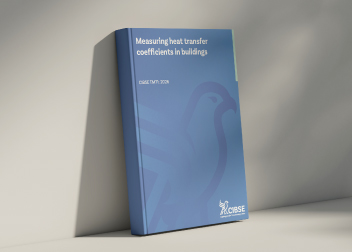
Elmhurst Supports Development of TM71 Guidance on Measured Building Performance
The Chartered Institution of Building Services Engineers (CIBSE) has published TM71: Measuring Heat Transfer Coefficients in Buildings, a new Technical Memorandum that provides the industry with a common framework for understanding, measuring and interpreting Heat Transfer Coefficients (HTCs) in buildings. Developed with support from Innovate UK, the guidance represents an important step towards greater use of measured building performance across the built environment.
Elmhurst Energy is pleased to have contributed to the development of the guidance, with Chris Ricketts, Head of Consultancy, serving on the independent steering committee alongside representatives from government, academia and industry. The steering committee helped shape the document to ensure it provides practical, robust and consistent guidance that can support professionals across the sector.
Why does TM71 matter?
For many years, building performance has largely been assessed using calculated values based on design assumptions. While these methods remain fundamental to compliance and energy assessment, growing evidence shows that buildings can perform differently from design.
TM71 helps address this challenge by bringing together best practice for measuring Heat Transfer Coefficients in real buildings. It standardises terminology, explains the different measurement methods available and provides guidance on validation, reporting and uncertainty, helping practitioners produce more consistent and comparable results.
This is particularly important as the industry continues to place greater emphasis on:
- Understanding how buildings perform in reality
- Improving the quality and effectiveness of retrofit projects
- Supporting more informed heating system design
- Identifying performance gaps between design intent and actual outcomes
- Strengthening quality assurance and consumer confidence
Moving from assumptions to measured building performance
At Elmhurst, we have long supported the principle that measured performance has an increasingly important role to play alongside calculated assessments.
Projects such as the Historic England Demonstrator have highlighted that the real-world performance of buildings can differ significantly from predicted values, reinforcing the value of gathering measured evidence to improve future modelling, retrofit decisions and building performance evaluation.
Rather than replacing existing assessment methodologies, measured performance provides another layer of evidence that can help the industry better understand how buildings behave in use, ultimately supporting more effective energy efficiency improvements and better outcomes for occupants.
As building policy continues to evolve and greater emphasis is placed on delivering real energy savings, the ability to verify performance will become increasingly valuable.
Supporting the future of measured performance
The publication of TM71 marks an important milestone in the industry’s journey towards performance-led building assessment.
By providing a common framework for measuring Heat Transfer Coefficients, the guidance will help improve consistency across research, retrofit, regulation and quality assurance, while supporting greater confidence in measured building performance.
Elmhurst welcomes the publication of TM71 and is proud to have contributed to its development through the steering group. We look forward to seeing the guidance support wider adoption of measured performance across the energy efficiency sector.

Chris Ricketts, Head of Consultancy at Elmhurst Energy was involved in the steering committee for the new guidance and comments:
The launch of TM71 is an important milestone for the industry. It provides the structure and consistency needed to ensure measured performance is trusted and comparable, which has historically been a challenge.”
At Elmhurst, we have already been developing training and competency around measured energy performance, so TM71 is a natural complement to that work. It helps provide the overarching framework that supports what assessors are delivering on the ground.

Richard Jack, Technical Director at Build Test Solutions was key to developing this new guidance and comments:
There have been heat transfer coefficient measurement methods since the oil crisis in the 1970s, from PSTAR and coheat, to SMETERs and QUB. Although the tests are well established, they’ve lacked the standardisation required to be adopted in policy and regulation, until now. TM71 marks the transition of heat transfer coefficient measurement from an insightful research activity to an everyday way to improve the performance and understanding of buildings. I hope that it paves the way to routine verification of building performance, both for new and existing buildings.
CIBSE TM71 Measuring heat transfer coefficients in buildings (2026)
Find out more about the new guidance below and get access to your copy of TM71.
GET ACCESS