
Ten Years On, Each Home Still Counts: Rethinking Consumer Protection for Retrofit
The Department for Energy Security and Net Zero has launched a consultation on major reforms to consumer protection for government-supported home upgrade schemes. The proposals follow serious concerns identified under ECO4 and the Great British Insulation Scheme (GBIS) , which includes poor-quality installations, fragmented oversight and difficult routes to remediation. The consultation asks how the system can be made simpler, more accountable and better able to prevent poor outcomes before they occur.
But many of the issues being raised today are not new.
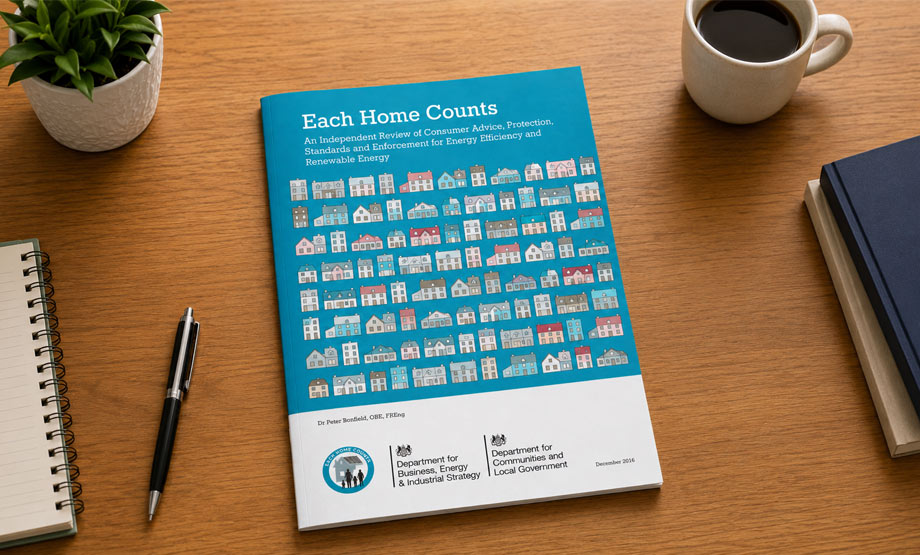
In 2016, the independent Each Home Counts review set out a vision for a trusted, consumer-focused retrofit market. It called for clearer standards, competent professionals, better use of property data, consistent monitoring and a single route for consumers to obtain advice and redress.
Its central message was straightforward: the right measures must be installed in the right homes, in the right way!
Nearly ten years later, the latest consultation provides an opportunity to return to those principles, examine why they have not been delivered consistently and ensure the next system works in practice.
What is the government proposing?
At the centre of the consultation is a new, end-to-end consumer protection service for government-supported retrofit schemes. This service could become the main point of contact for consumers, providing impartial advice, managing complaints and coordinating remediation and redress.
The wider proposals include:
- greater oversight from DESNZ and the proposed Warm Homes Agency;
- stronger contractual agreements with installers, certification bodies and retrofit professionals;
- clearer competence requirements;
- a centralised data platform;
- intelligence-led, risk-based auditing;
- stronger enforcement where standards are not met;
- an independent ombudsman for unresolved disputes.
The government is also considering whether parts of the system should be available to households paying for home improvements themselves, not just those using government-supported schemes.
Each Home Counts: the original ambition
Each Home Counts was an independent review commissioned by government and chaired by Dr Peter Bonfield, former chief executive of the Building Research Establishment (BRE). Its purpose was to review consumer advice, protection, standards and enforcement across the energy efficiency and renewable energy sector.
It identified a market that was difficult for consumers to navigate, with multiple schemes, certification routes and organisations operating across different measures. The review proposed a more joined-up framework built around:
- a recognisable quality mark
- a Code of Conduct
- clear technical standards and Codes of Practice
- a Consumer Charter
- an impartial Information Hub
- a property-level Data Warehouse
- nationally coordinated monitoring and enforcement, and
- a single point of contact for complaints and redress
Crucially, the review also called for a holistic, property-specific approach to retrofit. Rather than installing measures in isolation, each home should be considered as a complete system, taking account of its construction, condition, ventilation, moisture risks, occupancy and the way different improvement measures interact.
This recommendation helped shape the development of PAS 2035, which introduced a structured, whole-house approach to domestic retrofit. PAS 2035 requires improvement work to be based on an assessment of the individual property and managed through defined stages, including assessment, design, coordination, installation, monitoring and evaluation. Its purpose is to ensure that measures work together effectively, meet the needs of the occupants and minimise risks such as condensation, damp, poor ventilation and unintended damage to the building.
The principles established through Each Home Counts and subsequently embedded within PAS 2035 remain highly relevant. The challenge is no longer identifying what good consumer protection and high-quality retrofit should look like, but ensuring that these principles are applied consistently across schemes, organisations and the wider market.
Elmhurst’s Initial view
Elmhurst supports the government’s ambition to strengthen consumer protection and ensure that home upgrades are completed correctly first time. Clearer accountability, stronger competence requirements and a simpler route to remediation should help rebuild confidence in retrofit. However, the success of the reforms will depend on the detail.
The new system must avoid creating further duplication between DESNZ, the Warm Homes Agency, TrustMark, MCS, UKAS, certification bodies, building control and other existing organisations.
Responsibilities must also reflect the role each person or organisation performs. Assessors, coordinators, designers, installers and certification bodies have different responsibilities and different levels of control over project outcomes. They should not all be subject to the same obligations or sanctions.
Elmhurst supports better use of data and more intelligent, risk-based auditing. However, information used to assess the performance of professionals or businesses must be accurate, properly contextualised and open to challenge. AI may help identify patterns, fraud risks and emerging quality issues, but it should support professional judgement rather than replace it.
Back to the fundamentals
For Elmhurst, effective consumer protection starts with competence, accurate assessment and a clear understanding of the individual property.
Stronger contracts, more data and tougher enforcement will only succeed if the right decisions are made before work begins.
That means ensuring:
- consumers receive trusted and impartial advice
- assessments are accurate and property-specific
- measures are appropriate for the home
- professionals are properly qualified and competent
- responsibilities are clear throughout the supply chain
- monitoring is proportionate and evidence-led
- remediation and redress are straightforward
The consultation should not be treated as a blank sheet of paper. It is an opportunity to build on the foundations established by Each Home Counts, learn from where implementation has fallen short and create a system that delivers the outcomes originally intended.
Ten years on, each home still counts, and every household should be able to trust the advice, assessment and work carried out in its property.
Understanding the Changes Shaping the Year Ahead
Elmhurst Horizons brings together the major developments affecting energy assessment, retrofit and building performance across the UK.
The 2026 edition explores the latest policy changes, industry trends and emerging opportunities, including EPC reform, the Home Energy Model, the Warm Homes Plan, Minimum Energy Efficiency Standards, the Future Homes and Buildings Standards, Awaab’s Law and the growing focus on professional competence.
READ ELMHURST HORIZONS
The ‘Reforming Consumer Protection for Home Energy Upgrades’ Consultation closes on 10 September 2026, and Elmhurst will respond on behalf of its members.
VIEW CONSULTATION: https://www.gov.uk/government/consultations/reforming-consumer-protection-for-home-upgrade-schemes
EACH HOME COUNTS REVIEW (2015): https://www.gov.uk/government/publications/each-home-counts-review-of-consumer-advice-protection-standards-and-enforcement-for-energy-efficiency-and-renewable-energy