
Warm Homes Plan revealed: £15bn programme sets direction for home upgrades, EPC Reform and rental standards
After almost 2 years of waiting the detail surrounding the government’s multi-billion pound Warm Homes Plan has now been released, moving from a political promise to an operating government programme.
Positioned as the biggest public investment in home upgrades in British history, the Plan confirms £15 billion of public funding over the next five years to help households install measures including insulation, solar panels, batteries and heat pumps. The government says this investment could support upgrades in up to 5 million homes, cutting bills, improving comfort, and helping to lift up to one million families out of fuel poverty by 2030.

What is the Warm Homes Plan?
First set out as a key manifesto commitment ahead of the 2024 general election, the Warm Homes Plan was positioned as a national offer of grants and low-interest loans to unlock investment in insulation and other upgrades such as solar panels, batteries and low-carbon heating.
Delivery was framed around partnership with combined authorities, local and devolved government, alongside private finance support from lenders including banks and building societies. Labour also linked the Plan to a pledge to strengthen minimum energy efficiency standards in the private rented sector by 2030, while stressing that no one would be forced to rip out their boiler as a result of these policies.
Parts of the Plan are already being delivered through existing programmes running between 2025 and 2028, including the Warm Homes: Local Grant, allocating £500 million to England’s local authorities to upgrade poor energy performing homes occupied by low-income households, and the Warm Homes: Social Housing Fund, which awarded £1.29 billion to social housing providers to improve stock below EPC band C through energy efficiency measures.
What’s been announced in the Warm Homes Plan
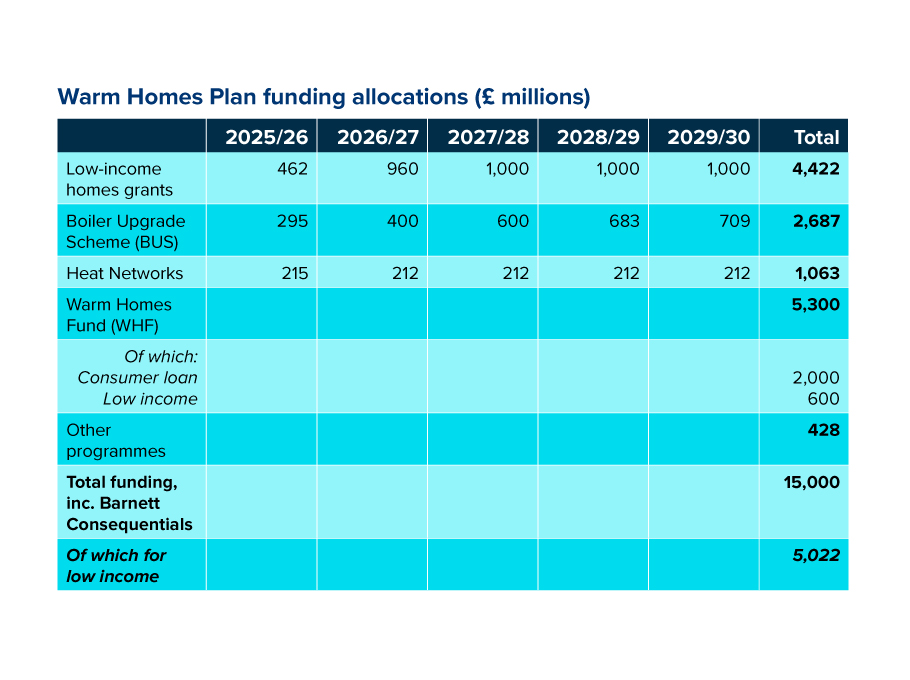
£5bn to fund upgrades for low-income households and those in fuel poverty
A central feature of the programme is a package of fully funded improvements for households on lower incomes, with measures tailored to what is most suitable for each home. This can include insulation and other fabric improvements, as well as clean energy technologies such as solar panels, batteries and heat pumps. The aim is to reduce energy costs permanently by improving how homes retain heat and by enabling households to generate and use more of their own power.
Support for the supply chain from supplier obligation to public funding
The Energy Company Obligation (ECO), a long standing scheme which enforced large energy suppliers are forced to pay for energy-efficiency improvements in people’s homes, is set to close at the end of March, as announced in the government’s recent budget. This has put the retrofit supply chain in a vulnerable position, with the security of work through ECO set to disappear.
To support that transition, the government has confirmed it will use new procurement arrangements for capital-funded schemes from April 2026, and will look to attach conditions to additional “top-up” funding so that grant recipients procure work through the existing ECO supply chain. A ministerially-led working group will oversee the shift from ECO to public funding, working with local authorities, social housing providers and supply chain representatives, with the intention of coordinating subcontracting opportunities and helping companies secure replacement work on capital-funded programmes.
In addition, the plan does suggest that ECO4 will be extended to 31st December 2026, but without increased delivery targets or impact on consumer bills. This is to allow additional time for remediation of non-compliant installations to be completed.
Finance to remove the upfront cost barrier for energy efficiency upgrades
For many owner-occupiers, the challenge is not whether an upgrade will deliver benefits, but whether they can afford the upfront cost. The Warm Homes Plan introduces government-backed low and zero-interest loans intended to make it easier for households to install technologies such as solar PV, batteries and heat pumps when they choose.
Alongside this, the Plan confirms continued support for low-carbon heating, maintaining the £7,500 heat pump grant via the Boiler Upgrade Scheme.
New protections for renters and clearer expectations for landlords
The Warm Homes Plan also establishes clear direction of travel for England and Wales domestic private rented sector, reflecting the fact that too many tenants live in homes that are cold, damp or prone to mould. The government’s approach combines stronger protections for renters with support for landlords to deliver upgrades over a fair transition period.
The ‘Improving the energy performance of privately rented homes’ consultation was released for response in 2025, and an update has now been provided through the Warm Homes Plan. This confirms that minimum energy efficiency standards (MEES) in the domestic private rented sector will be increased to EPC Band C with landlords needing to meet this standard across two new EPC metrics by October 2030 – this will apply to all tenancies. In addition the cost cap for improvements has been increased to £10,000, however, costs of improvements are predicted to be half of that.
Unfortunately, there has been no update to the same regulations which impact private rented commercial/non-domestic buildings.
New Warm Homes Agency
A new Warm Homes Agency (WHA) will be established to act as a dedicated public body leading delivery of the Warm Homes Plan and simplifying the customer journey. The agency is intended to bring together functions currently spread across different organisations, by closing Salix and consolidating relevant roles from government and Ofgem, so oversight and delivery are less fragmented and easier for households and installers to navigate. The WHA will offer impartial guidance on measures, eligibility and funding routes, and how to find trusted installers. It will also work closely with installers, manufacturers, retrofit businesses and trade unions to support workforce transition and training, helping the supply chain scale to meet demand.
The creation of quality jobs
In order to deliver the ambitions of this plan, the government anticipates that over time the number of jobs in energy efficiency and clean heating will increase from 60,000 in 2023 to up to 240,000 in 2030. This includes the likes of Retrofit Coordinators, heat pump and solar installers to name a few.
A partial update on EPC Reform
The government has also delivered a timely update on reforms to Energy Performance Certificates (EPCs), though the full outcome of the consultation still awaits release. The reason for this is that the new metrics that will be included on the new look EPC tie directly into updates to Domestic Private Rented MEES. As well as the release of the Warm Homes Plan, Government have also released their outcome to the consultation on Domestic Private Rented MEES. In a separate article, Elmhurst take a look at what this means for members, landlords and the wider industry, read here >.
What is changing for EPCs in England and Wales
- Government are aiming for new look EPCs to be introduced in October 2026, with new metrics provided
- The new headline Metrics will be:
- Energy Cost: providing information on how much a property may cost to run, an important aspect for consumers.
- Fabric performance: assessing the thermal performance of a building’s envelope
- Heating system: providing information on the efficiency and environmental impact of a building’s heating source
- Smart readiness: assessing a building’s potential to integrate smart technologies that can optimise energy consumption
- To support the transition to the new domestic EPC, Government will retain the legacy EER metric to enable comparison with existing certificates and to ensure continued compliance with current regulations until it is no longer required.
- The scope of EPCs will be extended covering more buildings, including Government considering requiring a new EPC when an existing one expires for all private rented buildings
- The validity period of EPCs will remain at 10 years
- EPCs will be required at the point of marketing a property, rather than the point of sale or rent, ensuring consumers have appropriate information when making a purchasing decision
Based on this new information, from October 2026, EPCs in England, Wales and Northern Ireland are set to diverge significantly from those used in Scotland, with different headline metrics shown on the certificate and a different approach to validity.
In addition to the announced changes to EPCs Government have also released a consultation on EPC banding in relation to the Home Energy Model (HEM), the calculation methodology which will eventually power the EPC from behind the scenes. We will provide updates and thoughts on this in due course.
Elmhurst’s Response
Elmhurst’s Managing Director, Stuart Fairlie, welcomes the scale and ambition of the Warm Homes Plan, but stresses that lasting success will depend on strong consumer protections and a well-managed transition for the retrofit supply chain:
“Lifting one million households out of fuel poverty by 2030 is an inspiring target, and committing £15 billion to upgrading the nation’s homes is a major step in the right direction.
“This Plan signals a clear shift in emphasis, from traditional insulation-led, ‘fabric first’ approaches toward greater deployment of solar PV, battery storage and low-carbon heating. That makes it encouraging to see support for the training and skills needed to deliver these technologies well, at scale, and with the quality consumers expect.
“However, the success of any programme of this size will ultimately be judged on delivery and consumer confidence. Our scrutiny will be on whether the Warm Homes Plan finally closes the long-standing consumer protection gap that has undermined previous schemes. Properly independent assessment and effective retrofit coordination, carried out by suitably qualified professionals, is absolutely vital.
“We also recognise the disruption caused by the move away from supplier obligations, and it’s positive to see commitments to support the affected workforce and supply chain, so that capable businesses can move from ECO into public-funded delivery routes without losing momentum.
“The creation of the Warm Homes Agency is another important step. If it genuinely simplifies a complex landscape, strengthens oversight, and provides trusted consumer advice, while working closely with installers, manufacturers, retrofit businesses and trade unions, it can help rebuild confidence and accelerate delivery at scale.
“We also welcome a small update to EPC reform, which will be an important enabler for industry and delivery of the Warm Homes Plan. However, the new EPC approach will introduce metrics that can be complex for homeowners to interpret, so consumer education and clear guidance will be essential if EPCs are to support better decisions rather than create confusion. The validity period also presents a missed opportunity a ten-year EPC lifespan risks leaving households, lenders and landlords relying on out-of-date information.”
“Moreover, we welcome the update on domestic MEES and the direction of travel for rented homes. But net zero will not be achieved through homes alone, so we also need stronger momentum behind non-domestic MEES to bring the commercial and public building stock forward consistently.”
Related Links
https://www.gov.uk/government/news/families-to-save-in-biggest-home-upgrade-plan-in-british-history
https://www.gov.uk/government/consultations/home-energy-model-energy-performance-certificates
https://www.gov.uk/government/consultations/reforms-to-the-energy-performance-of-buildings-regime