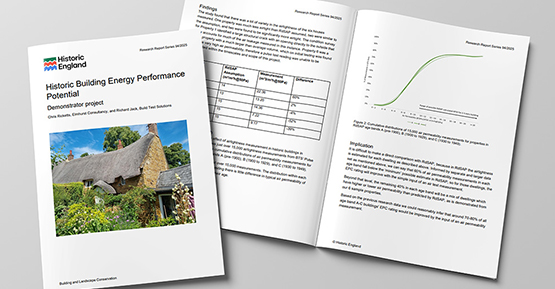
Measured vs Assumptions: Lessons from the Historic England Demonstrator Project
The recently published Historic Building Energy Performance Potential: Demonstrator Project highlighted the challenges and complexities of understanding and evaluating the energy performance of traditionally constructed buildings. Elmhurst played a key role throughout the project, collecting EPC input data, conducting condition surveys, and leading the comparative analysis that tested long‑standing EPC assumptions against in‑situ measured evidence.
What did the data reveal?
The findings re-enforce how measurement of building performance metrics can inform energy models and compliment assumptions and calculations within RdSAP. EPCs have necessarily relied on generalised inputs to maintain consistency and comparability across the housing stock. But this project demonstrates that such assumptions can fail to reflect how heritage buildings actually perform. It could be said this could extend to our standard housing stock throughout the UK.
Across the six study properties, Elmhurst’s analysis of air permeability, U-values and whole-house heat loss (HTC) found that traditionally constructed buildings frequently perform better than RdSAP defaults assume. Measured improvements included:
| 31% | 34% | 45% |
| better airtightness | better U-Values | lower whole-house heat loss (HTC) |
The Implications for EPC Banding and Retrofit decisions
These are not marginal variations. When the measured data was entered into the RdSAP calculations, mirroring what an EPC could show if future methodology allowed, it shifted EPC outcomes by 5 to 17 SAP points, in some cases lifting buildings by an entire band.
For years, heritage buildings have been perceived as presenting the “hardest-to-treat” retrofit challenge. Yet the project shows that default EPC assumptions often underestimate their true baseline performance, overstating the interventions required to reach policy targets such as EPC Band C.
Elmhurst’s role in the project
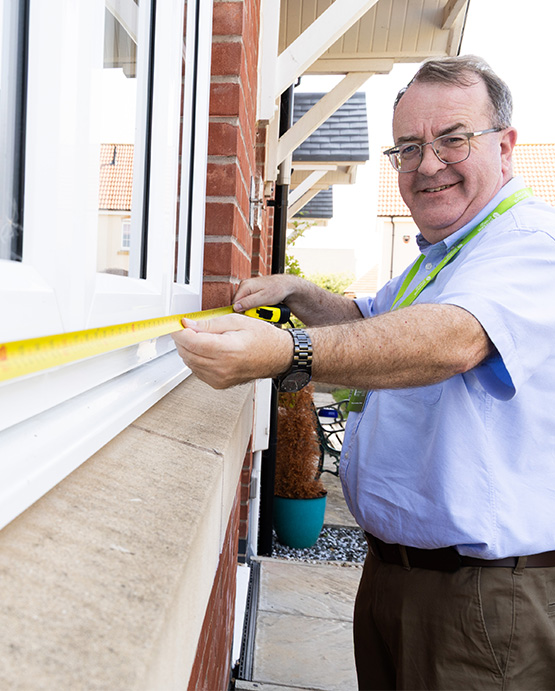
Elmhurst’s involvement extended well beyond standard EPC surveys. While Build Test Solutions collected in‑situ measurement data, Elmhurst:
- conducted all RdSAP 10 EPC data collection;
- carried out visual condition surveys to contextualise performance results;
- integrated measured data into incremental modelling scenarios, and
- delivered the interpretation and critical appraisal comparing predicted vs measured performance.
This dual role, capturing baseline EPC data and then interrogating it with real measurements, uniquely positioned Elmhurst to demonstrate where EPCs succeed, where they fall short, and what would be required to evolve them for heritage buildings.
An opportunity to strengthen EPCs with measured data
The project showed that measured airtightness, U‑values and HTC results can diagnose discrepancies between assumed and actual performance, enabling:
- targeted identification of heat‑loss pathways;
- more proportionate and technically suitable retrofit recommendations.
- improved risk management around moisture, ventilation and fabric condition.
- avoidance of unnecessary or unsuitable interventions (e.g., inappropriate insulation).
Crucially, two of these metrics In-situ U‑values and HTC are not currently allowed as EPC inputs. Airtightness testing is the only measurable value that can be entered into an EPC today. Elmhurst’s modelling demonstrated how powerful the shift could be if all three were allowable, aligning with Historic England’s recommendation for a future “Enhanced Technical Suitability Assessment” combining EPC analysis, condition surveys and measured diagnostics.
Building the Skills for a Heritage-Competent Workforce
Our findings and analysis highlighted the importance of upskilling assessors in airtightness testing, U‑value measurement and HTC assessment, emphasising these as core competencies needed for any future Heritage Task Force. Elmhurst already delivers this capability.
Elmhurst already provides:
- Airtightness testing training (including Pulse and blower‑door methodologies. Airtightness Testing & Background Ventilation
- HTC/whole‑house heat loss training, ensuring assessors understand SmartHTC, co‑heating and diagnostic pathways. Measured Energy Performance
and is developing:
- In‑situ U‑value measurement competency, covering both Heat Flux and infrared/Heat3D approaches
These skills are not just add‑ons, they are the diagnostics that underpin accurate evidence‑based retrofit planning for buildings, not just older and traditional, exactly as demonstrated within the project. Elmhurst’s training offer directly aligns with the project’s call for a more qualified, more capable assessor workforce able to deliver enhanced, risk‑aware assessments for traditional buildings.
The report’s findings make a compelling case for reforming how EPCs treat older buildings. The path forward is clear:
- Integrate measured data where practical.
- Mandate condition surveys for context and moisture risk.
- Equip qualified assessors with the knowledge to know when to suppress unsuitable recommendations.
- Develop a national heritage‑competent assessor network.
- Evolve RdSAP RdSAP to reflect real-world measured building performance.
Elmhurst’s role, both in this project and in sector training, positions the organisation at the forefront of these reforms. By bridging EPC methodology with real‑world diagnostics, Elmhurst is helping ensure that future policy, retrofit funding and homeowner decisions are grounded in accurate, contextual understanding rather than assumptions.
The Historic England Demonstrator Project offers a positive message for heritage buildings: many perform better than we think. But it also highlights a clear need to modernise our assessment framework. With its expertise in EPC assessment, measured diagnostics and national assessor training, Elmhurst is ready to support that transition, helping ensure that the UK’s historic buildings receive retrofit advice that is accurate, proportionate and fully aligned with their unique construction and performance characteristics.
Read the full report
To read the full Historic Building Energy Performance Potential: Demonstrator Project click below
READ FULL REPORT